Pages

Showing posts with label Birmingham Alabama. Show all posts

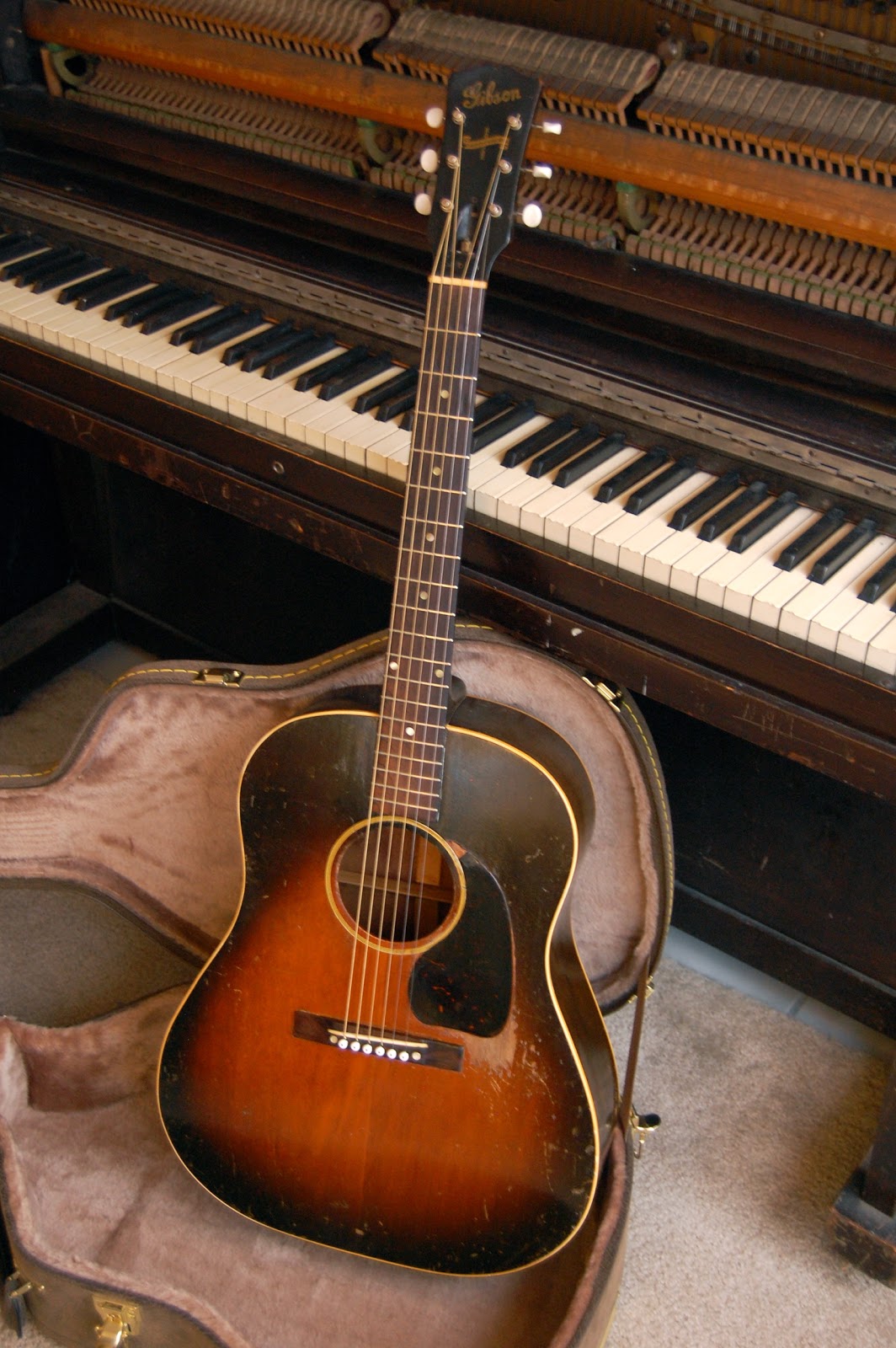
1944 Gibson J-45 "Only a Gibson is good enough"

The banner on Gibson's wartime flat-tops appeared around June of 1942 and disappeared sometime in 1946.  It is still a but unclear why but we may know more about the banner after this book comes out: Kalamazoo Gals.  Maybe it had something to do with national pride during the war years since the Martin guitar company was still family owned and the original CF Martin was in fact, a German immigrant.  This is solely speculation though, It may have had nothing to do with Martin.


This guitar was probably made in 1944 but again, that is just a guess.  It bears no visible factory order number and may have never received one which is common for the late war years.  It was constructed of a two piece Spruce top and a solid, one piece flat-sawn Mahogany back.  The one piece back is of note because it is evidence that wood stock piles were low so "lower quality" wood was used.  The Mahogany should have been quarter sawn for appearance and strength however this process wastes more wood than the flat sawing method.  Also of note, the Kalamazoo Gals that built this guitar were told to put "back strips" on the interior of the guitar to help the two joined quarter sawn pieces of Mahogany.  Yet this guitar has a one piece back.


I mention this because the people that built this guitar were probably not men who had worked in the factory for many years.  More than likely they were "Rosie the Riveters" that filled the empty positions of men who had gone to support the war effort.  In John Thomas' book, "Kalamazoo Gals," an argument is made that these guitars were somewhat superior to other Gibsons because of the nature of the women who made them.  These women had been working with their hands all of their lives.  They may not have been making guitars but they were very skilled nonetheless.  Since the book is not out yet I cannot say that this is the exact point or argument made.  I am very excited about the book as you can imagine!


One thing that I have noticed as a pattern of the banner Gibsons is that they have a distinctive percussive "thump" that vibrates throughout the entire instrument when a string is struck.  My experience is limited since I have played only as many banners as you can count on two hands but it is certainly a pattern.  A friend once described the thump of this exact instrument to be akin to a "lapping", as if from the tongue.  I thought that was a great way to describe it since thump would indicate a bit bass heavy, which these guitars are not.  I am worthless when it comes to describing tone with words so just bear with me.


I have three banner J-45s: one spruce and mahogany, one all mahogany and one in the mail that is spruce and flame maple.  The maple banner is still in the mail and should arrive in a couple of days.  I'll be doing two more posts on the other two banners later this month.  Do you have a banner Gibson?  Send some pictures to my email at tvguit at gmail.  I don't want to post the actual email for fear of bots.

TVG

1939 Gibson J-35, 3 tone bars of blues.

The model designation "J-35" showed up in the ledgers in late 1936.  It was a no frills jumbo featuring a Spruce top and Mahogany back and sides.  It was originally named the "Trojan" but not for very long.  It is my understanding that the word Trojan only shows up one time.  The Trojan guitar differs very little from the J-35, if at all.

-Edit-  As our friend mentioned in the comments section, the "Trojan" model appears 39 times in the surviving shipping ledgers from 1936.  Only one had an attached FON: 960-12 which shipped to Ridders Music Store in Atlanta.  This guitar still lives in Atlanta and while I do not know the owner personally I have interacted with him on the Gibson forum.  He is a well respected collector and I hope to one day be able check out the collection in person.  I live only 2 hours west of Atlanta!  There is a lot of TVG material there.  Thanks, Anonymous!


The J-35 was produced up until 1942 when Gibson introduced the next and more common J-45.  This J-35 was made in 1939 which was the first year that the natural finish was offered.  It was also the last year of the 3 tone bar bracing.  That makes this one a bit easier to date since Spann's Guide to Gibson does not have very many factory order numbers from 1939.


This guitar was being sold locally and was described as a "1939 Gibson L-00."  I am still trying to figure out how they nailed the year perfectly but were terribly mistaken on the model.  I tried to tell the seller what it actually was but, as is common with sellers, they don't want you to tell them what they should already know.


When I opened the case for the first time I was very surprised at how good of condition it was in.  This guitar survived in a chipboard case in someone's basement for many, many years.  The seller told me it had some water damage but he repaired it.  That was not what I wanted to hear but upon inspection, he did a pretty good job.  I was expecting sloppy glue work and half-assed overspray but was pleasantly surprised to find neither.  There was plenty of evidence of water damage but it was on the bottom near the end pin.  It wasn't a perfect repair but it was done well.  I wouldn't have expected much better from my own luthier.  He then told me he was a wood worker so it made a little more sense.


I bought this guitar 5 days before the Orlando Guitar Expo and had already bought a booth to show some guitars.  I took this one because I just couldn't resist.  It sold the morning of the first day to a very happy buyer.  I was sad, yes, but it had to be done.  I had spent the last bit of our savings including my wife's last couple of paychecks!  Not a great way to buy a guitar but I had a pretty good feeling about this one.  It seemed to work out but now there is a big J-35 shaped hole in my heart.  I guess that is one of the things that keep me going.

TVG


1967 Harmony H59 Rocket... Version 2

If you have followed this blog for a while you might remember my first Rocket (Rocket Version 1).  If you read through that post then you might have seen the comment by a guy about his Harmony Rocket.  Well, here it is!


This Harmony Rocket was built in 1967 in Chicago.  Harmony made this version of the Rocket from '66 to '67.  Sometime between '67 and '68 they discontinued the single cutaway and produced instead the double cutaway version which I am not a very big fan of.


I am a huge fan of the second incarnation of the gold foil pickups though.  Some call these "double mustache" pickups.  They are very similar to the gold foils except these have adjustable poles and aren't quite as hot.  I played this guitar back to back with my Harmony Bobkat (Gold Foils).  It seems like the Double Mustaches wouldn't give me all the tube saturated goodness that I have been getting out of the Gold Foils.  It still needs a bit more set up so I'll have to keep working on it.


Let's mention the elephant in the room, as it were.  This guitar is so clean that you might think someone sold me a reissue.  This is not a reissue.  This is the real deal down to the date stamp on the back of the pickups:


I was skeptical at first too.  The finish is shiny and shows no checking.  The frets are tarnished a bit but have almost no playing wear.  The only thing that was wrong with this guitar when I got it was that the rivets in the bridge pup were loose.  I tweaked them a bit and popped them back in and it is good to go now.  I might clean up the pots a bit when I get the chance.


One unique thing about these Harmony guitars is that the necks don't taper towards the headstock but are one uniform width the whole way.  If you are used to a Fender or Gibson neck then the first 3 frets might feel a bit wide and the 12th fret area might feel a bit skinny.  It really doesn't feel that different to my hands unless you have just put down another guitar.


My previous Rocket had a rather serious design flaw: no adjustable truss rod.  By 1965 Harmony realized that wouldn't fly any more especially with their weaker Poplar necks.  This one is lucky to have one but really doesn't need any adjustment.  In fact, I don't think any of the screws/nuts had been turned before I took the pickups off for cleaning.  Unfortunately there is really not a good way to tell if that is true until you try to turn the screws!


Here is Brittany Howard of the Alabama Shakes with her favorite guitar:  1966 Harmony Rocket H54/1.  It is very similar to the H59 except it has only two pickups and is the double cutaway version.  Have you heard the Shakes yet?  Go check them out.  Here is what Brittany says about her Harmony Rocket in an interview for innocentwords.com: 
"I have a '66 Harmony Rocket that I am in love with.  It's cherry red.  I play it out of a '66 Silvertone 1483 with an intact Jensen 12" speaker.  It can glitter, it can growl, it can rock, it can lull you to sleep.  So far, it's the perfect rig."
I have GOT to get me a Silvertone 1483.  I have been looking for a good 60s Silvertone amp for a while.  I think it is safe to say that Brittany is a fan of her rig.  What do you think about her tone?  Leave a comment and let me know what you think.


Another Nick Lucas.... This one is probably a little later

This Nick Lucas walked into the local shop that I frequent.   My ears perked up when I heard about it even though I knew it was a bit rough.  Since there were only 57 (but about 200 have been found/documented, an estimated 400 total produced thanks to some forum knowledge, thanks TM) documented Nick Lucas Specials produced in any body style, one showing up locally is quite an occurrence.


I told you it was rough, but I could not care any less.  The Gibson Nick Lucas Special is my favorite flat-top guitar ever.  What makes them so special is the combination of appointments, scarcity and body depth.  Of course, I am not the only one who thinks the NL is special.  Here is Bob Dylan with his.


The first Nick Lucas Special is believed to have been produced in 1928 with a list price of $125.  The first models shared the same body dimensions as the L-1 and L-3 (like the previous NLS that I wrote about).  This guitar features the 0 and 00 body width but retains the deeper body much like the L-1.  It also has 14 frets clear of the body instead of 12.  The serial numbers on NLS guitars often date to '28 or '29 even though they were often made much later.  I don't have the FON on this one but I would guess '34, '35 or '36 because of width of the burst and the Maple back and sides.  


Here is a shot of the interior.  I don't think the interior of this guitar has been worked on much because I don't see any ugly reglued braces.  You can pretty easily see the loose back braces.  I would venture to guess that they would just fall out if you nudged them.  The top braces are probably in about the same condition.  The owner is taking no chances on this guitar: he is sending it to Ren Ferguson of Gibson Montana fame.  Ren is not only responsible for turning Gibson's acoustic offerings around at the end of the 80s but is also a top notch guy.  He took the time to talk to me (just a nerdy guitar kid) about how they came up with the idea for using Walnut on the Gibson Jackson Browne Signature model among other things.


I am absolutely thrilled that the owner decided to send this guitar to Ren.  The guitar may even be more valuable just because Ren worked on it (at least it is to me!).  It will probably take him a long time since Ren has been quite busy as of late.  You may have heard that he is working with Fender (Guild).


Here is the back of the Nick.  You can see the gorgeous flame maple peeking through that Cremona Brown sunburst.  It has plenty of nicks and scratches but it really isn't that bad.  I don't think it was even dusted off at the time of this picture.  Looks like whoever played it used one of those nasty capos that took chunks out of the back of the neck.  Pet peeve of mine.


Here is the label on the Nick.  I love seeing the hand written model numbers/names.  The handwriting is usually very elegant which is very rare these days.  I know my handwriting is terrible!  This appears to have been filled out in error though.  The space after "Gibson" should say "GUITAR" and the style should say "Nick Lucas Special."  I thought at first that this was even the wrong label but a friend from a forum informed me that the they used this label on the Maple NLSs.  The original label looked like this:


I'm not sure if they ran out of them or just stopped using them.  That is one interesting thing about Nicks is that they often have strange features.  As my friend says about Gibsons, "If it perfectly matches the description then it is probably fake."  They had a couple of different body shapes, 3 different types of wood for the back/sides and many different style bridges.  These are true custom made guitars.  It is estimated that 300-400 were produced over 11 years in a time where Gibson was slapping guitars together with whatever they had around.


Here is one repair we can clearly see.  The fretboard has been planed about halfway down.  I'm not sure if that was a result of a neck set or a couple of refrets.  I will guess that it is a result of a whole bunch of refrets because the fret wire they used was much softer than what they use now.  I didn't really see any evidence of a neck set either.  Although, I know it will need a neck set now. 

Leave it to Ren,  he will get this sad looking Nick in tip top shape.  I'll do another post when it comes back.  I might be able to include a video!  We will see what the owner will allow.

TVG


1928 Gibson Nick Lucas... from an email

I'm active on a couple of guitar nerd forums and I like to look out for cool guitars.  The Gibson Nick Lucas Special is one of my all-time favorite guitars ever produced.  Here is an email that I got from the grandson of the original owner of this guitar:


My grandfather bought a new Gibson Nick Lucas back in the twenties. He never got around to learning how to play it and it sat in its case until he gave it to my brother in the late Fifties. It sat under his bed until I found it in the early Sixties.

It had been strung up and ignored for decades. The action was redunkulous. I didn't know any better since it was the first guitar I had ever touched. Many sore fingers later I heard about light gauge strings and tuning down. In the meantime it was handled with absolutely no care by an ignorant teenager - me. I dropped a clock radio on it, several times - note the huge gouges. 

Eventually i took it to a guitar shop where they "improved" it by filing down the original bridge to get the action a little better. I took off the open gear tuners and drilled holes for shiny new closed gear Grovers. The tuners were a great improvement, but - now the guitar wouldn't fit in the case unless I took off the D and G pegs!

I got a Dearmond soundhole pickup and played slide for quite awhile. I had a neck reset in the Nineties and have been playing fingerstyle with it tuned down a whole step ever since. 

According to the guys at Gibson, the serial number (in pencil) on the label indicates it was made in 1926 but that doesn't match up with the description on the Gibson Nick Lucas reference page. Mine has the pearl "The Gibson" and the notched diamond inlay at the third fret. It is a 12 fretter so my best guess is late 1928. That makes it 85 years old sometime this year. August 22 is Nick Lucas's birthday. :)

This guitar has been rode hard and put away wet. It is LOUD! It sounds clear and true. Rings for days. Playing up towards the neck produces a wide warm tone and playing down by the bridge gets a crisp sound. This is true of every guitar but is really remarkable on my Nick. The "improvements" and hard wear probably make it a lot less desirable to a collector, but I have no plans of setting it loose in this lifetime.  

Neither of my sons plays guitar but maybe my grandson will someday.   

It is very rare to have a full history on a guitar.  Thank you BmoreTele for sending me this.  A very cool guitar indeed.


TVG 

On buying old, broken guitars before you can hear them

Most of the guitars that I buy are finds- as in they have been in a closet or under the bed for 30 years.  That means that they usually need a fair amount of repair like loose braces, neck sets, lifting bridges, etc.  When they need these kind of structural repairs I can't play them before buying.  I can't always hear how they will sound after being fixed up before I buy them.  It can be a bit of a gamble.  Here are a couple of those gambles.


This was probably the biggest gamble of all.  This is a 1943 Gibson J-45.  This has the fabled "banner" gracing the headstock that was only present during the war years.  I bought it from the grandson of the original owner.  The back braces, tone bars and finger braces were all loose.  The owner could not be convinced of this fact for some reason.  He had strings on it at full tension which caused the action to be very high.  I bought it anyway because I wanted a banner.

This was a GREAT bet.  I figured it would need a neck set but after the braces were glued tight the neck set was perfect.  It has almost factory saddle height.  The tone is warm, dry and very responsive.  You can feel the pluck of each string deep in your chest.  Suffice it to say they were right about the banners.


This 1955 Gibson J-50 was a recent gamble.  It was listed as a '54  and was about an hour and a half from Birmingham.  I could tell from the pictures that while the tuners were there the buttons were not.  I just happened to have bought an old Kay with period Klusons for next to nothing the week before!  When I got the guitar in my hands I could tell that the bridge had been shaved meaning that it probably needed a neck set.  I bought it anyway.

This is a very special guitar and probably the best gamble of all.  I took it straight to my local shop where my friend Keith works.  We put the extra set of Klusons on and strung it up.  As he was winding the strings I could hear that familiar hollow thump typical of the round shoulder Gibsons.  At full tension we immediately knew that this was not just an average 50s Gibson.  It was loud, nuanced, responsive and most of all LOUD.  I'm talking bluegrass loud.  We couldn't hear each other talking over the rumbling E chord.  Then we took it into the acoustic room to compare it to some new guitars.  We soon realized that this was guitar of myth and that it could never leave our circle of pickers.


This is a 60s Silvertone (Harmony Sovereign), I can't remember the Silvertone number designation.  I bought it from a different local shop needing a neck set.  When they got it in the called me because they knew I love the American made solid wood guitars.  They just said it was a Silvertone.  When I walked in I immediately recognized the distinctive bean shape and pinless bridge as a rebranded Sovereign.  I was ecstatic.  They thought I was crazy for buying a hard case for it.

The neck set was easy because the dovetail had already shifted in the joint.  I strung it up and started strummed some cowboy chords and fell head first in love with Sovereigns.  The J-45s sat in their cases for a few days while I became acquainted with it.  It had the rumble of a J-45 but sounded more bluesy- no, boxy.  This was probably a result of the ladder bracing.  Sometimes I just want to strum my favorite chord progression and belt out the lyrics.  This guitar was just about perfect for that.  It had the magic and can be had for less than $500.  Don't be fooled by the price, this is a professional instrument.  I sold it to a big time session player in Nashville.  It is a safe bet to say that you have heard him play.


It is a special feeling to strum an old guitar for the first time.  It is even more exhilarating when you have a bunch of time and money invested in it!  Maybe I have just gotten lucky but I have never had a bust- yet.   If you find one of these for a good deal then don't be afraid.  Take the plunge.

TVG


A Semi-Rarity: The 1966 Epiphone Wilshire (USA!)

Vintage guitars often come with a trade off: the "good ones" got played- hard.  As a result they have lots of character.  I don't mind character- in fact I love it.  I like seeing some scratches in the top of a guitar or the wear marks on the side of the neck from 60 years of first position chords.  Every once in a while however I will come across one that is clean.  This Wilshire, my friends, is CLEAN.


In 1957, Gibson bought a financially failing company that had been their long time competitor.  The Epiphone brand was known for very fine instruments like banjos, archtop electrics and acoustic guitars.  The competition was especially fierce in the large body electric archtop market.  Gibson would come out with a big jazz box and a month later Epiphone would come out with a slightly bigger or more fancy one.  Epiphone manufactured out of New York until about 1953 manufacturing moved to Philadelphia (although the labels still said New York!).  The failing company was at odds with its employees and the name was eventually bought along with a bunch of parts by Gibson.

Gibson began manufacturing Epiphone guitars first with leftover parts and continued by introducing their own Epiphone models.  This was a move by Gibson to get more guitars in stores.  Retailers didn't want 10 Gibson SGs but didn't really have a problem buying 5 SGs and 5 Epiphone Wilshires.  The USA Epiphones were made right along sides of the Gibsons in the factory at 225 Parsons Street, Kalamazoo, MI.  These are very high quality instruments!  The quality of the instruments bearing the Epiphone brand didn't drop to the current level until that unfortunate time in the 70s when the new owners of the Gibson brand (Norlin) shipped all production over seas to Japan.


The Epiphone Wilshire was a bit of a rare model until the its reissue this past year (made in China- sadface).  It has always had a small Mahogany body and neck but had two different editions.  The first was introduced in 1959 with a 3+3 headstock and P-90 pickups.  The second version appeared in mid-1962 that had a funky "batwing"style headstock and two mini humbuckers.  Mine is the second version with the silky smooth mini hums.


I absolutely love these guitars.  They have the coolest 60s styling with quality ingredients to boot.  The mini humbuckers are very versatile and can take you from Guns and Roses to Neo-classical jazz in a real hurry.  The neck joins at the very last fret so the player has full advantage of the fretboard.  Unfortunately the "Vibrola" was a source of frustration for most players so the trem arm is usually taken off and lost.


This is my second mid 60s Epiphone Wilshire.  My first one had seen some playing time and the finish showed it.  It was still original (but was missing the trem arm of course).  I eventually sold it but still had my love of Wilshires.  When I saw the ad for this one I couldn't believe it.  The seller was the original owner and the finish looked like it had just rolled off the assembly line.  I asked him when and by whom it was refinished.  He said that it hadn't been refinished.  Well, I have heard that before.  I always take that kind of thing with a grain of salt.

When I showed up to look at the guitar I still couldn't believe it hadn't been refinished.  We met outside of a Waffle House so I couldn't really take the pickguard off to check.  It looked "right" so I went ahead and bought it.  I took the pickguard off but the wires kind of stuck.  I looked closely to see what was going on.  Yes, the wires were stuck in the lacquer.  I carefully peeled them away to find that I was the first one to ever take the PG off.  This was clearly the original finish.  There was even a little bit of router dust in the electronics cavity.  That was a cool moment but I totally regretted it after!  I knew I had to take the pg off to verify the originality of the finish and electronics but I wish that it had still "never been taken off."  Oh well.


There is no checking on this guitar.  NONE.  It looks like it was made recently.  This thing is as real as it gets.  There are a couple of nicks around the guitar (about 3).  That is all. The original owner was not keen on the original set of tuners so he had them changed to mini Schallers.  He also lost the tremolo arm.  Other than that, this is the way it came from Kalamazoo.  One thing that is weird is that the gold Epiphone silk screen logo was done once, painted over, and done again slightly more centered.  Must have been a new guy at the silk screen booth that day.

The seller said he went into the shop in '67 to buy a Gibson SG.  He saw this one up on the wall and bought it instead.  Good call.  I don't think he played it very much because it has hardly any fret wear or wear on the back of the neck.  It is an absolute joy to play I hope you get a chance to play one of these oddities sometime too.


I took this guitar to the Nashville guitar show and another dealer was interested in it.  He took it over to an amplifier and played it for a while.  When he came back he told me that the pickups were wire out of phase!  That was news to me but I wouldn't have noticed it because I stick mainly to the neck pickup.  I took it out this morning and messed around with it and found that he was probably right.  One other thing I found interesting is that the bridge pup is rotated 180 degrees from where it "should" be.  I asked the original owner why he swapped it and he said that he didn't.  That is the way that it came from the factory.

Peter Green's 1959 Gibson Les Paul was made this same way in that his pickups are wired out of phase as well.  Apparently it is more common than originally thought but most people probably didn't notice it.  Maybe they just played on the neck pickup too...

TVG


Harmony Bobkat Video Blog

I picked up this Harmony Bobkat a couple of days ago.  I didn't feel like writing tonight but I wanted to get the word out about these so I made a quick video about it.  Check it out, comment, disagree, like it, share it.... participate.


I just wanted to show that while I could be playing much more expensive and technically "better" guitars, instead I am playing this one.  You don't have to pay 3 grand to get a solid vintage guitar.  Price does not translate into quality, playability or tone.  The price of a vintage guitar is only the result of supply and demand.  Most of the time the demand for a guitar and its overall tone/quality go hand in hand but there are always exceptions.  I believe this is one of them.


This girl is tearin' up this Bobkat!  Good stuff!


The $200k Les Paul's little brother: 1960 Gibson Melody Maker

According to Gibson's website, the Melody Maker was the best selling guitar at the time.  It was cheap and looked cool too.  They produced them on the same line that made Les Pauls, ES-335s and J-200s.


The Melody Maker was a full scale guitar with trimmed down features. The body is solid Mahogany but is much thinner than a standard guitar at 1 3/8ths" thick.  It has only one single coil pickup made specifically for this model.  The neck is a full size standard neck except the headstock doesn't have the "wings" glued on the side like a standard Gibson.  


This guitar was owned by a blues player and you can tell!  He played and played it.  It has a nice aged patina but still fully playable and has all the original parts.  I bought this guitar and two others from the brother-in-law of the blues player.  The other guitars I bought from him were a 1964 Fender Duo-Sonic and a 1946 Gibson J-45.  They all have a distinctive wear mark where he put his arm and shoulder over the guitar.  This wear doesn't photograph well but this picture shows it the best.  


The guitar is all original but the case is clearly not.  It is from the late 60s/early 70s.  It fit the guitar well and protected it much better than the chipboard case that it probably came in.  That case is long gone.


 This guy must have been a hell of a player!  He played these things all the way through the finish on the neck.  It feels good- very good.  I guess he figured they needed to be broken in before they played well.  He may have been right!  Many people would pay big money to have their guitar "relic"ed like this.  Now I know why.

The neck retains the 50s style big full neck.  It has the standard width with just enough depth to feel full.  The is the same neck shape that would be on a Les Paul from the same year.  The fretboard is Rosewood but is flat-sawn instead of quarter (like would be on a Les Paul).  I've seen this one some J-45s from the late 50s as well (email guitar).


This simple layout includes a jack, tone, volume and pickup.  You could take all of the electronics out by removing the pickguard if the ground didn't go to the bridge post.  


Some have described the Melody Maker single coil as a cross between a P-90 and a Tele neck pickup.  I would say that it is closer to the Tele pickup but a bit darker.  


 Do you have one of these?  Send me a picture!