Pages

Showing posts with label L-1. Show all posts

1934 Gibson L-00 from Instagram

I like to post pictures of guitars on Instagram and sometimes I will search hash tags for other old guitars.  Today I found this one, a 1934 Gibson L-00.  Neither the guitar or the pictures belong to me (unfortunately!).


This guitar, bearing the batch number 1212 - 31 was manufactured in 1934 according to Spann's Guide to Gibson: 1902-1941.  It features the smaller sunburst typical of the early 30s.  Supposedly the sunburst was small because wood supplies were not very good during the depression.  The black part of the sunburst served to cover up imperfections in the wood.


Structurally, this guitar is very similar to my '33 L-00.  One way that it differs is in the lining used to join the sides to the top and bottom of the guitar.  You can see from the photo above that this guitar has the modern, kerfed lining.  My guitar has the solid, steam bent lining.  See below:


There was a soldier overseas during World War II that wanted to someday be a touring Country Western musician.  He bought this guitar used upon his return from the war.  He followed his dream for a while but soon opted for the life of a family man instead of that of a touring musician.  He still played every once in a while with some other musicians.  He played this guitar until his death.  It was then passed on to his granddaughter where she displays it proudly on her wall.


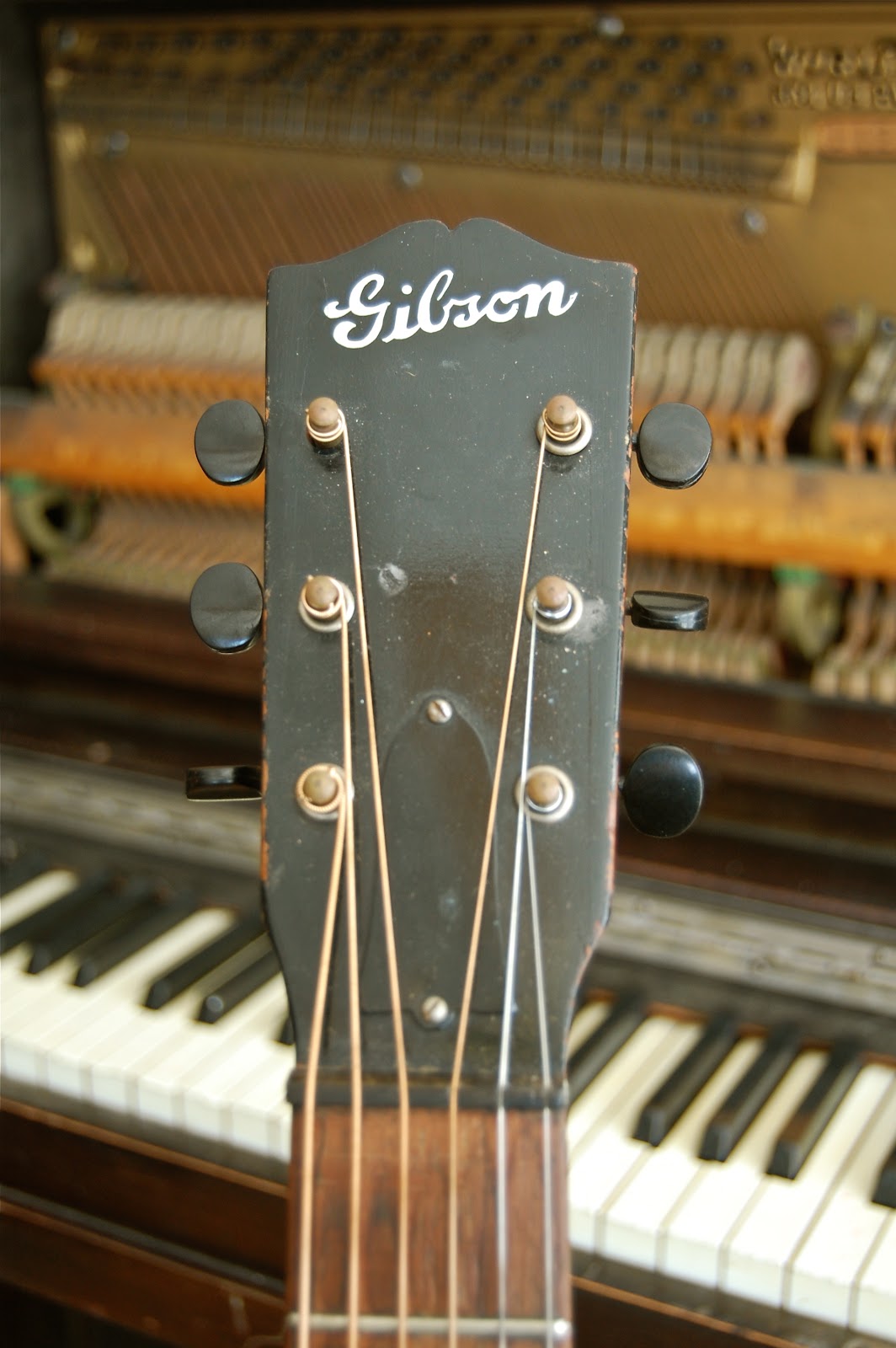
The tuners have been changed but they look very similar to what would have been on there.  I think that these are the cheaper tuners that Harmony used on their guitars in the 60s.  Everything else on the guitar looks to be original.  I don't see any bad repairs but I don't have any shots of the underside of the top.


What a stunning little Gibson!  After I wrote this I took mine out of its case and played Mississippi John Hurt's version of "Make Me a Pallet on the Floor" and remembered why these are so popular for fingerstyle blues.

TVG

Pre-war Gibson Flat-top: 1933 Gibson L-00

When I was back in school I was lucky enough to find a guy with an early 50s J-45 and a mid to late 30s L-00.  I knew the J-45 was for me so I quickly sold off the L-00.  Mistake.  The thing had been played and played and needed a neck reset but it felt so good.  Sounded even better.  When I got word of this one for sale I was ecstatic.


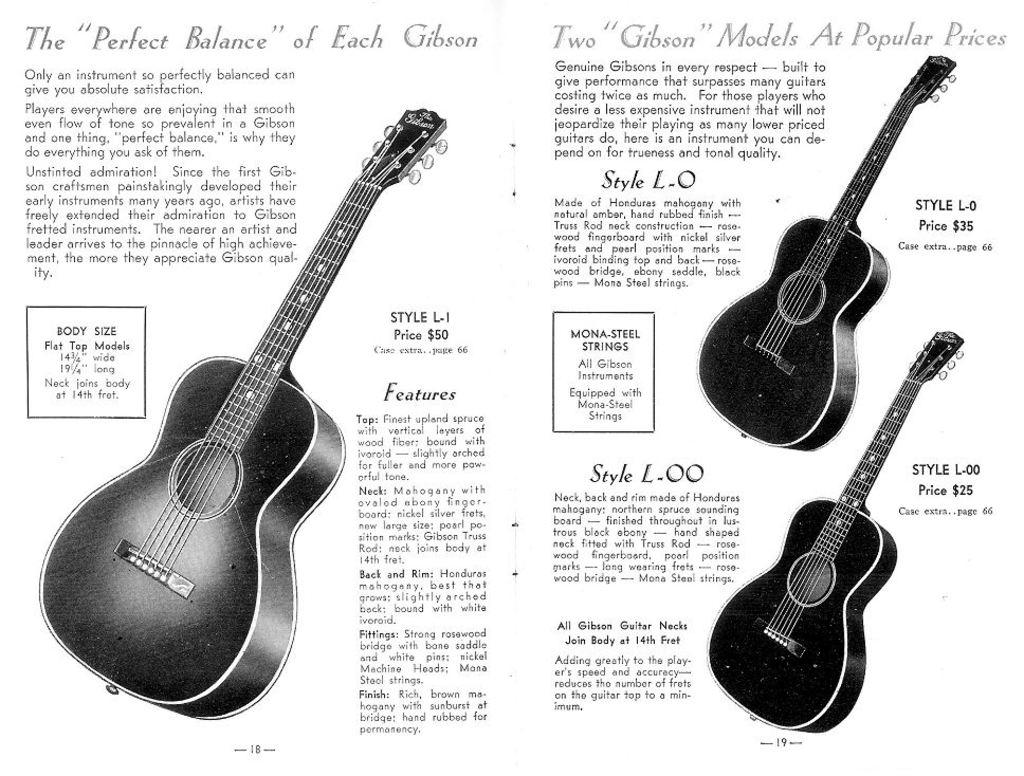
The L-00's first catalogue appearance was in 1932 but supposedly they had been making them since 1929.  They were Gibson's budget model flat-top guitar.  They were lightly built cheapies that were made out of whatever they had around at the time.  Consequently, the features tend to be a bit sporadic.  They all feature Adirondack Spruce tops and Mahogany back and sides.  The L-00 began as a 12 fret guitar but changed to 14 in '33.


This advertisement is kind of interesting.  The 00 is on the lower left and just beside the body of the guitar is a short paragraph about how they are using 14 fret necks for more comfort and fret board access.  You may have noticed that none of the guitars picture have 14 fret necks.  This is typical of Gibson I guess, sigh.


This particular L-00 has a bit of a story attached to it.  Before I had seen it in person I saw a few pictures from the owner.  One showed the back of the headstock.  I could see a little impression in the lacquer that I recognized as a "Made In USA" stamp.  This was the marker that Gibson used on all export instruments that went outside of the US.  But I found this guitar in Tennessee??  I was a bit perplexed because almost all of the instruments that come my way are "finds" as in not from a dealer so how did this guy get this thing anyway?


After talking with the owner for a bit I got the story on how he came to own the guitar.  His uncle was housing a drifter for a while but the drifter had no way to pay him.  All he had was this guitar so he used it as payment.  The uncle had no use for the instrument so when his nephew showed an interest in music he gave it away.  That was a long time ago.  The owner had made his way to the states by way of Canada- the missing link in the story.


This guitar was easy to date as far as vintage Gibsons go.  I saw from the pictures that it had a small burst so I knew it was early to mid 30s.  The Factory Order Number was easy to read: 876 which appeared in the ledgers in 1933.


The neck on this old guitar has a wide 1 3/4" nut width with a fairly defined "V" shape that I find very comfortable.  I'm not sure why this shape has fallen out of vogue.  Fingerstyle blues just feels "right."  The neck is straight, frets properly dressed and the action is very comfortable.  I was looking for signs of a neck reset but I couldn't find them.  I believe that this is the original neck angle.  The saddle is kind of low but not as low as I would expect.  There is still a bit of room to come down if needed.


Some of the guitars from this era have some kind of ugly wood.  They have been seen with three piece tops and backs and off center seams.  Supposedly this was the reason for the small burst: most of the wood was not very aesthetically pleasing so the burst served to cover it up.  For some reason this guitar was spared of ugly wood.  The top is a nice 2 piece book matched Spruce and the back is a solid piece of close-to-quarter sawn Mahogany.  The sides are both quarter sawn.  I say close to quarter because it looks like this piece was very close to the center of the tree.  Here is what I mean by quarter sawn vs. flat sawn:


Quarter sawn wood has a higher strength to weight ratio but wastes more wood.  It is considered higher quality because of its features and scarcity.


The Tone Report:  Open, woody, Americana.  If you closed your eyes and just listened to it you might mistake it for a much larger guitar.  However, it is much different than a dreadnought.  It is more nuanced and sweet.  They are fantastic for fingerpicking.  The notes are clearly defined as well as balanced.  If you plan on strumming away your Nickleback chords then you may want to stay away from a 00.  The boom and sparkle probably won't be enough for you (as well as other obvious problems with that situation).


Dating this Gibson L-00 was relatively easy with the features and Factory Order Number.  The number is 867 which according to Spann's Guide to Gibson means 1933.  The other features were the small burst which was done in the early 30s and the solid kerfing on the interior of the guitar.  This is the lining that provides a solid glueing surface for the rims to the top and back.  This was mostly used in the late 20s and very early 30s.  There are some exceptions such as my friend's '32 L-00 that has standard cut pieces of Mahogany.  Here is a shot of the solid kerfing:


And the FON:


I'm really excited to have another L-00.  I really love fingerstyle blues and this is the guitar to have for that (except for maybe an L-1?).  I thought I liked the larger burst of my last one better but I've changed my mind.  The small burst is unique and the reasons behind it are representative of the times in which it was built.