Pages

Showing posts with label L-00. Show all posts

1934 Gibson L-00 from Instagram

I like to post pictures of guitars on Instagram and sometimes I will search hash tags for other old guitars.  Today I found this one, a 1934 Gibson L-00.  Neither the guitar or the pictures belong to me (unfortunately!).


This guitar, bearing the batch number 1212 - 31 was manufactured in 1934 according to Spann's Guide to Gibson: 1902-1941.  It features the smaller sunburst typical of the early 30s.  Supposedly the sunburst was small because wood supplies were not very good during the depression.  The black part of the sunburst served to cover up imperfections in the wood.


Structurally, this guitar is very similar to my '33 L-00.  One way that it differs is in the lining used to join the sides to the top and bottom of the guitar.  You can see from the photo above that this guitar has the modern, kerfed lining.  My guitar has the solid, steam bent lining.  See below:


There was a soldier overseas during World War II that wanted to someday be a touring Country Western musician.  He bought this guitar used upon his return from the war.  He followed his dream for a while but soon opted for the life of a family man instead of that of a touring musician.  He still played every once in a while with some other musicians.  He played this guitar until his death.  It was then passed on to his granddaughter where she displays it proudly on her wall.


The tuners have been changed but they look very similar to what would have been on there.  I think that these are the cheaper tuners that Harmony used on their guitars in the 60s.  Everything else on the guitar looks to be original.  I don't see any bad repairs but I don't have any shots of the underside of the top.


What a stunning little Gibson!  After I wrote this I took mine out of its case and played Mississippi John Hurt's version of "Make Me a Pallet on the Floor" and remembered why these are so popular for fingerstyle blues.

TVG

Another Nick Lucas.... This one is probably a little later

This Nick Lucas walked into the local shop that I frequent.   My ears perked up when I heard about it even though I knew it was a bit rough.  Since there were only 57 (but about 200 have been found/documented, an estimated 400 total produced thanks to some forum knowledge, thanks TM) documented Nick Lucas Specials produced in any body style, one showing up locally is quite an occurrence.


I told you it was rough, but I could not care any less.  The Gibson Nick Lucas Special is my favorite flat-top guitar ever.  What makes them so special is the combination of appointments, scarcity and body depth.  Of course, I am not the only one who thinks the NL is special.  Here is Bob Dylan with his.


The first Nick Lucas Special is believed to have been produced in 1928 with a list price of $125.  The first models shared the same body dimensions as the L-1 and L-3 (like the previous NLS that I wrote about).  This guitar features the 0 and 00 body width but retains the deeper body much like the L-1.  It also has 14 frets clear of the body instead of 12.  The serial numbers on NLS guitars often date to '28 or '29 even though they were often made much later.  I don't have the FON on this one but I would guess '34, '35 or '36 because of width of the burst and the Maple back and sides.  


Here is a shot of the interior.  I don't think the interior of this guitar has been worked on much because I don't see any ugly reglued braces.  You can pretty easily see the loose back braces.  I would venture to guess that they would just fall out if you nudged them.  The top braces are probably in about the same condition.  The owner is taking no chances on this guitar: he is sending it to Ren Ferguson of Gibson Montana fame.  Ren is not only responsible for turning Gibson's acoustic offerings around at the end of the 80s but is also a top notch guy.  He took the time to talk to me (just a nerdy guitar kid) about how they came up with the idea for using Walnut on the Gibson Jackson Browne Signature model among other things.


I am absolutely thrilled that the owner decided to send this guitar to Ren.  The guitar may even be more valuable just because Ren worked on it (at least it is to me!).  It will probably take him a long time since Ren has been quite busy as of late.  You may have heard that he is working with Fender (Guild).


Here is the back of the Nick.  You can see the gorgeous flame maple peeking through that Cremona Brown sunburst.  It has plenty of nicks and scratches but it really isn't that bad.  I don't think it was even dusted off at the time of this picture.  Looks like whoever played it used one of those nasty capos that took chunks out of the back of the neck.  Pet peeve of mine.


Here is the label on the Nick.  I love seeing the hand written model numbers/names.  The handwriting is usually very elegant which is very rare these days.  I know my handwriting is terrible!  This appears to have been filled out in error though.  The space after "Gibson" should say "GUITAR" and the style should say "Nick Lucas Special."  I thought at first that this was even the wrong label but a friend from a forum informed me that the they used this label on the Maple NLSs.  The original label looked like this:


I'm not sure if they ran out of them or just stopped using them.  That is one interesting thing about Nicks is that they often have strange features.  As my friend says about Gibsons, "If it perfectly matches the description then it is probably fake."  They had a couple of different body shapes, 3 different types of wood for the back/sides and many different style bridges.  These are true custom made guitars.  It is estimated that 300-400 were produced over 11 years in a time where Gibson was slapping guitars together with whatever they had around.


Here is one repair we can clearly see.  The fretboard has been planed about halfway down.  I'm not sure if that was a result of a neck set or a couple of refrets.  I will guess that it is a result of a whole bunch of refrets because the fret wire they used was much softer than what they use now.  I didn't really see any evidence of a neck set either.  Although, I know it will need a neck set now. 

Leave it to Ren,  he will get this sad looking Nick in tip top shape.  I'll do another post when it comes back.  I might be able to include a video!  We will see what the owner will allow.

TVG


1928 Gibson Nick Lucas... from an email

I'm active on a couple of guitar nerd forums and I like to look out for cool guitars.  The Gibson Nick Lucas Special is one of my all-time favorite guitars ever produced.  Here is an email that I got from the grandson of the original owner of this guitar:


My grandfather bought a new Gibson Nick Lucas back in the twenties. He never got around to learning how to play it and it sat in its case until he gave it to my brother in the late Fifties. It sat under his bed until I found it in the early Sixties.

It had been strung up and ignored for decades. The action was redunkulous. I didn't know any better since it was the first guitar I had ever touched. Many sore fingers later I heard about light gauge strings and tuning down. In the meantime it was handled with absolutely no care by an ignorant teenager - me. I dropped a clock radio on it, several times - note the huge gouges. 

Eventually i took it to a guitar shop where they "improved" it by filing down the original bridge to get the action a little better. I took off the open gear tuners and drilled holes for shiny new closed gear Grovers. The tuners were a great improvement, but - now the guitar wouldn't fit in the case unless I took off the D and G pegs!

I got a Dearmond soundhole pickup and played slide for quite awhile. I had a neck reset in the Nineties and have been playing fingerstyle with it tuned down a whole step ever since. 

According to the guys at Gibson, the serial number (in pencil) on the label indicates it was made in 1926 but that doesn't match up with the description on the Gibson Nick Lucas reference page. Mine has the pearl "The Gibson" and the notched diamond inlay at the third fret. It is a 12 fretter so my best guess is late 1928. That makes it 85 years old sometime this year. August 22 is Nick Lucas's birthday. :)

This guitar has been rode hard and put away wet. It is LOUD! It sounds clear and true. Rings for days. Playing up towards the neck produces a wide warm tone and playing down by the bridge gets a crisp sound. This is true of every guitar but is really remarkable on my Nick. The "improvements" and hard wear probably make it a lot less desirable to a collector, but I have no plans of setting it loose in this lifetime.  

Neither of my sons plays guitar but maybe my grandson will someday.   

It is very rare to have a full history on a guitar.  Thank you BmoreTele for sending me this.  A very cool guitar indeed.


TVG 

Pre-war Gibson Flat-top: 1933 Gibson L-00

When I was back in school I was lucky enough to find a guy with an early 50s J-45 and a mid to late 30s L-00.  I knew the J-45 was for me so I quickly sold off the L-00.  Mistake.  The thing had been played and played and needed a neck reset but it felt so good.  Sounded even better.  When I got word of this one for sale I was ecstatic.


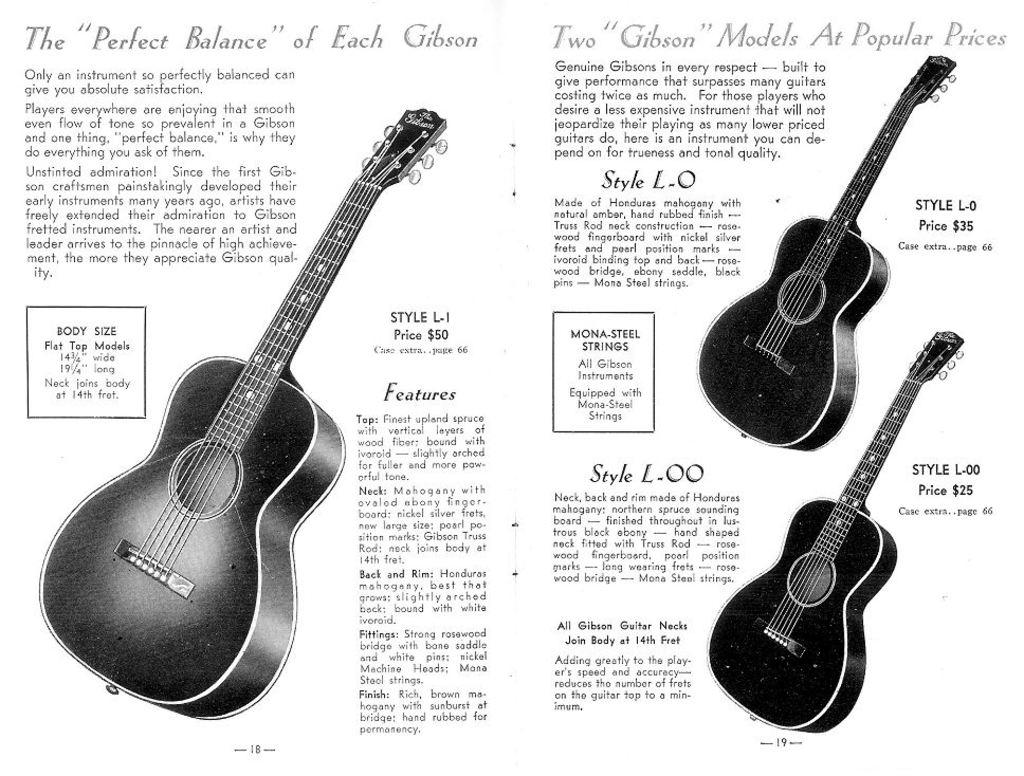
The L-00's first catalogue appearance was in 1932 but supposedly they had been making them since 1929.  They were Gibson's budget model flat-top guitar.  They were lightly built cheapies that were made out of whatever they had around at the time.  Consequently, the features tend to be a bit sporadic.  They all feature Adirondack Spruce tops and Mahogany back and sides.  The L-00 began as a 12 fret guitar but changed to 14 in '33.


This advertisement is kind of interesting.  The 00 is on the lower left and just beside the body of the guitar is a short paragraph about how they are using 14 fret necks for more comfort and fret board access.  You may have noticed that none of the guitars picture have 14 fret necks.  This is typical of Gibson I guess, sigh.


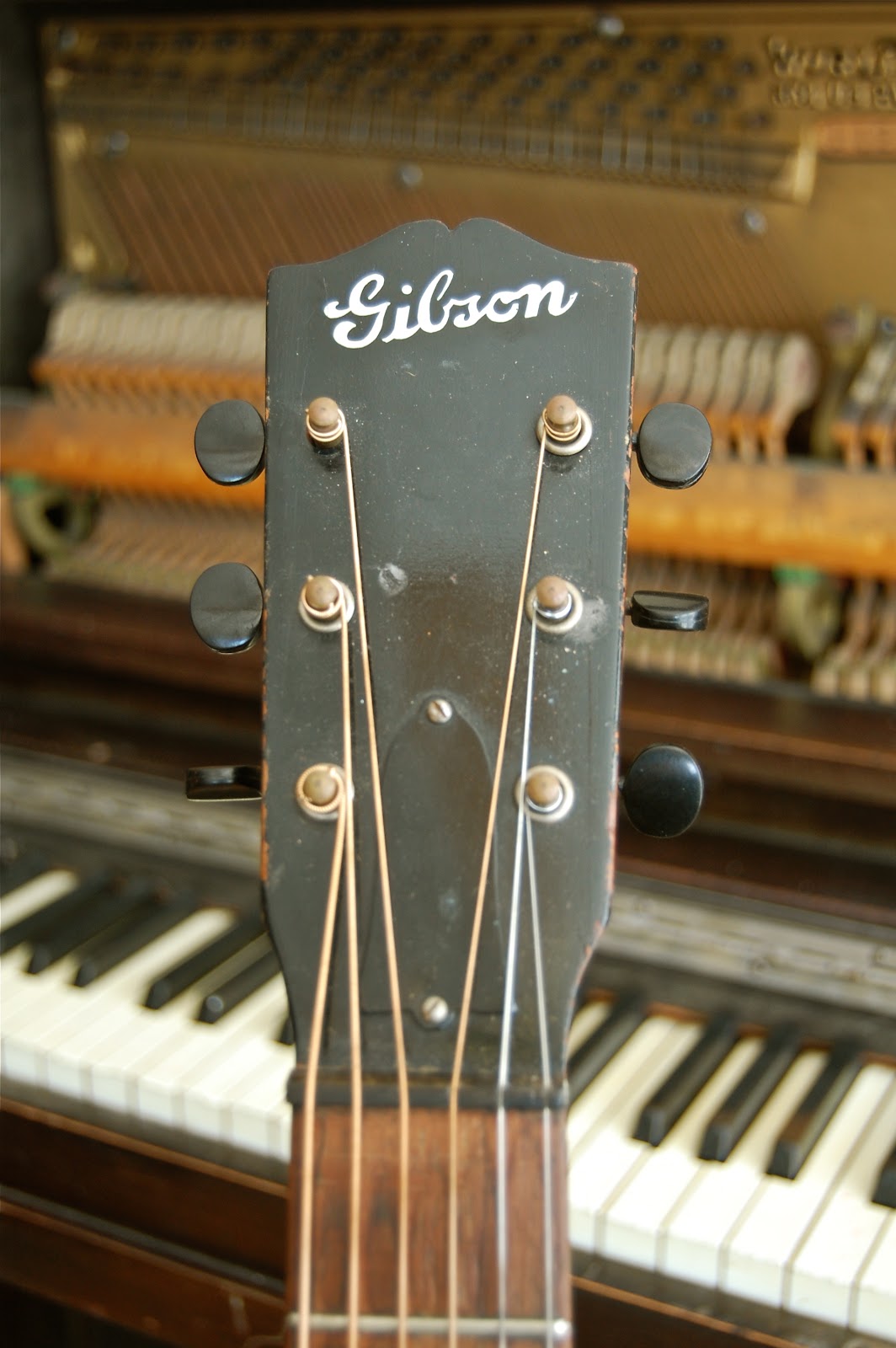
This particular L-00 has a bit of a story attached to it.  Before I had seen it in person I saw a few pictures from the owner.  One showed the back of the headstock.  I could see a little impression in the lacquer that I recognized as a "Made In USA" stamp.  This was the marker that Gibson used on all export instruments that went outside of the US.  But I found this guitar in Tennessee??  I was a bit perplexed because almost all of the instruments that come my way are "finds" as in not from a dealer so how did this guy get this thing anyway?


After talking with the owner for a bit I got the story on how he came to own the guitar.  His uncle was housing a drifter for a while but the drifter had no way to pay him.  All he had was this guitar so he used it as payment.  The uncle had no use for the instrument so when his nephew showed an interest in music he gave it away.  That was a long time ago.  The owner had made his way to the states by way of Canada- the missing link in the story.


This guitar was easy to date as far as vintage Gibsons go.  I saw from the pictures that it had a small burst so I knew it was early to mid 30s.  The Factory Order Number was easy to read: 876 which appeared in the ledgers in 1933.


The neck on this old guitar has a wide 1 3/4" nut width with a fairly defined "V" shape that I find very comfortable.  I'm not sure why this shape has fallen out of vogue.  Fingerstyle blues just feels "right."  The neck is straight, frets properly dressed and the action is very comfortable.  I was looking for signs of a neck reset but I couldn't find them.  I believe that this is the original neck angle.  The saddle is kind of low but not as low as I would expect.  There is still a bit of room to come down if needed.


Some of the guitars from this era have some kind of ugly wood.  They have been seen with three piece tops and backs and off center seams.  Supposedly this was the reason for the small burst: most of the wood was not very aesthetically pleasing so the burst served to cover it up.  For some reason this guitar was spared of ugly wood.  The top is a nice 2 piece book matched Spruce and the back is a solid piece of close-to-quarter sawn Mahogany.  The sides are both quarter sawn.  I say close to quarter because it looks like this piece was very close to the center of the tree.  Here is what I mean by quarter sawn vs. flat sawn:


Quarter sawn wood has a higher strength to weight ratio but wastes more wood.  It is considered higher quality because of its features and scarcity.


The Tone Report:  Open, woody, Americana.  If you closed your eyes and just listened to it you might mistake it for a much larger guitar.  However, it is much different than a dreadnought.  It is more nuanced and sweet.  They are fantastic for fingerpicking.  The notes are clearly defined as well as balanced.  If you plan on strumming away your Nickleback chords then you may want to stay away from a 00.  The boom and sparkle probably won't be enough for you (as well as other obvious problems with that situation).


Dating this Gibson L-00 was relatively easy with the features and Factory Order Number.  The number is 867 which according to Spann's Guide to Gibson means 1933.  The other features were the small burst which was done in the early 30s and the solid kerfing on the interior of the guitar.  This is the lining that provides a solid glueing surface for the rims to the top and back.  This was mostly used in the late 20s and very early 30s.  There are some exceptions such as my friend's '32 L-00 that has standard cut pieces of Mahogany.  Here is a shot of the solid kerfing:


And the FON:


I'm really excited to have another L-00.  I really love fingerstyle blues and this is the guitar to have for that (except for maybe an L-1?).  I thought I liked the larger burst of my last one better but I've changed my mind.  The small burst is unique and the reasons behind it are representative of the times in which it was built.


The One(s) That Got Away

Half the fun of vintage guitars are their history and the path they took to get to me.  Some of the guitars I have bought came with pictures of the original owners and stories about how all those scratches came to be (most have to do with the owner drinking a lot).  Sadly, the sellers are rarely the ones that owned the guitar for so long.


I'm not always successful in my pursuit of vintage flat-tops.  Sometimes it will get snagged by someone else or the owner decides not to sell.  Here are a few of the ones that got away.


I was really upset about this one.  This is a mid forties Gibson Southern Jumbo.  The seller didn't really know what he wanted for it but invited me to come take a look.  It was in Knoxville, TN which is quite a drive from the school I was attending in Tuscaloosa (Roll Tide).  Long drives have rarely gotten in the way of a me and a guitar so I was planning to leave after my last class that day.  I called the seller back after class let out and it was sold.

This was the only picture I had of it but it was all I needed to know this was a real banner Southern Jumbo.  The split parallelogram inlays on the neck told me it was a SJ and not a J-45.  The belly down bridge combined with the lack of binding on the neck told me that this was most likely wartime (meaning is has the desirable banner on the headstock).  I should have skipped class!!


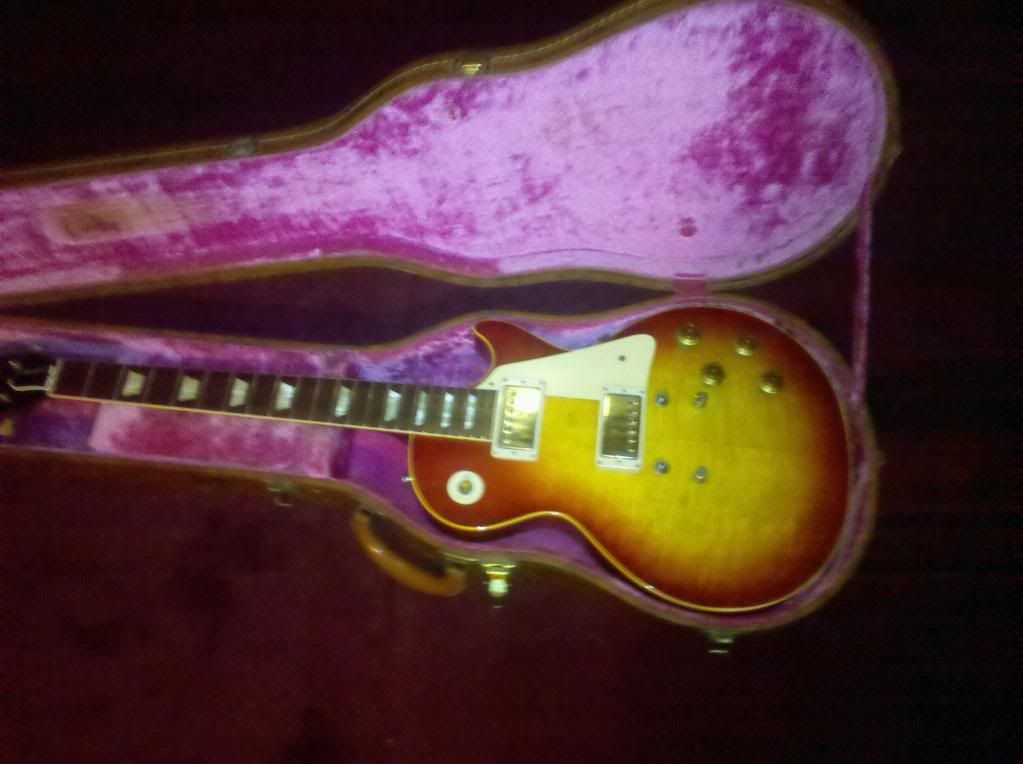
 Yes.  You are seeing this correctly.  This is a 1958 Gibson Les Paul with the original case.  This one was in northern Florida and I couldn't believe my eyes.  Most of the pictures you see of these floating around without a price tag of 200k+ are fakes.  This one was not.  I spoke with the owner and she said that she had already sold it by the time I even saw the ad.  She was working on taking the ad down and was having trouble.  Figures.


There was a musician who passed away in Cullman, AL in 2008.  His family was ready to sell off his collection of 10 instruments but they didn't know anything about any of them.  I had found a picture of this guy online that showed him holding a late 30s Gibson J-35:


I was a bit disappointed when I showed up to take a look at the collection.  It was pretty much all junk.  There was no J-35 or anything close.  There was a jacked up parts telecaster, a squire strat, a plywood parlor guitar.  That was the best of the lot and I was not really interested.  I thanked old lady that survived the man and on my way out the door she handed me this picture:


I turned to her and asked politely, "Where is this guitar?  We need to find it."  She didn't know anything about it.  Supposedly there was a blackface deluxe too but it wasn't there.  I figured that all this stuff had been picked over long ago and I was too late.  WRONG.  I was too ill-informed!  A year or two later I found this picture that I had taken:


With the help of my buddy Keith we came to the conclusion that this is that blackguard tele!!!  But how, you ask?  The neck is changed, the pickguard, hardware, all changed.   Take a look at the screws.  There are 5 old screws and one new one.  The holes are in the right place for a black guard Telecaster.  The body has been poorly refinished but I would be willing to bet that this was that telecaster- right before my eyes and I missed it!  Who knows what parts of the electronics were original.  Maybe none, maybe all.  I called the lady back and she said she had sold it a while back.  Still kicking myself.  The moment that you think you know what you are doing is when you find out that you really don't!


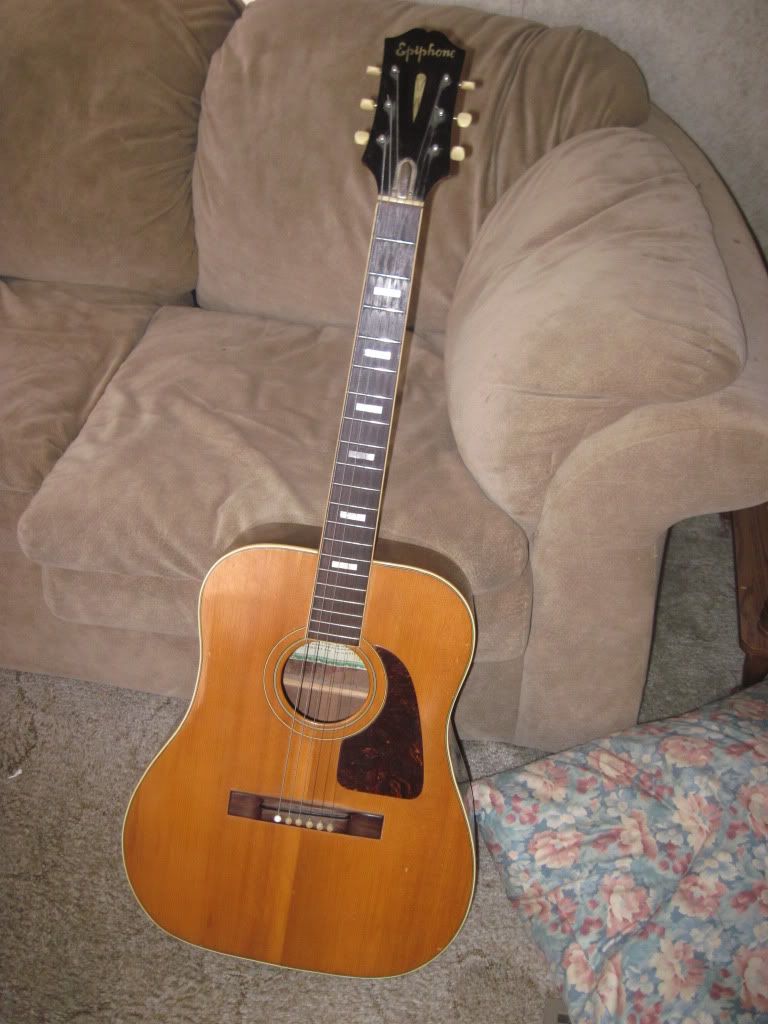
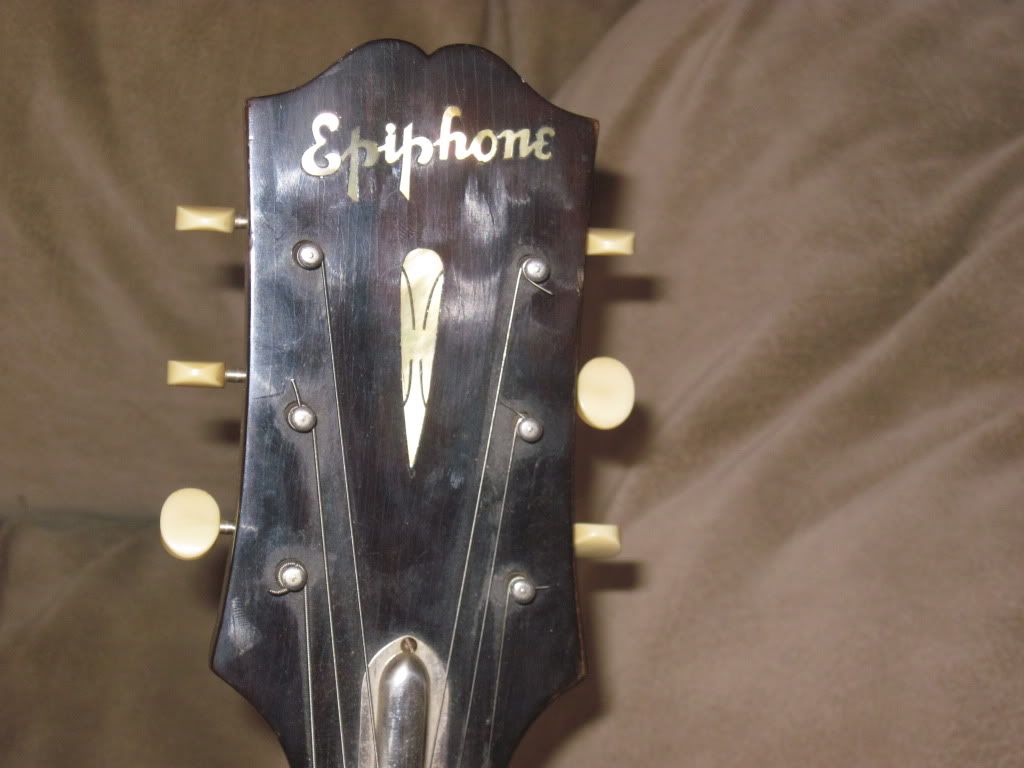
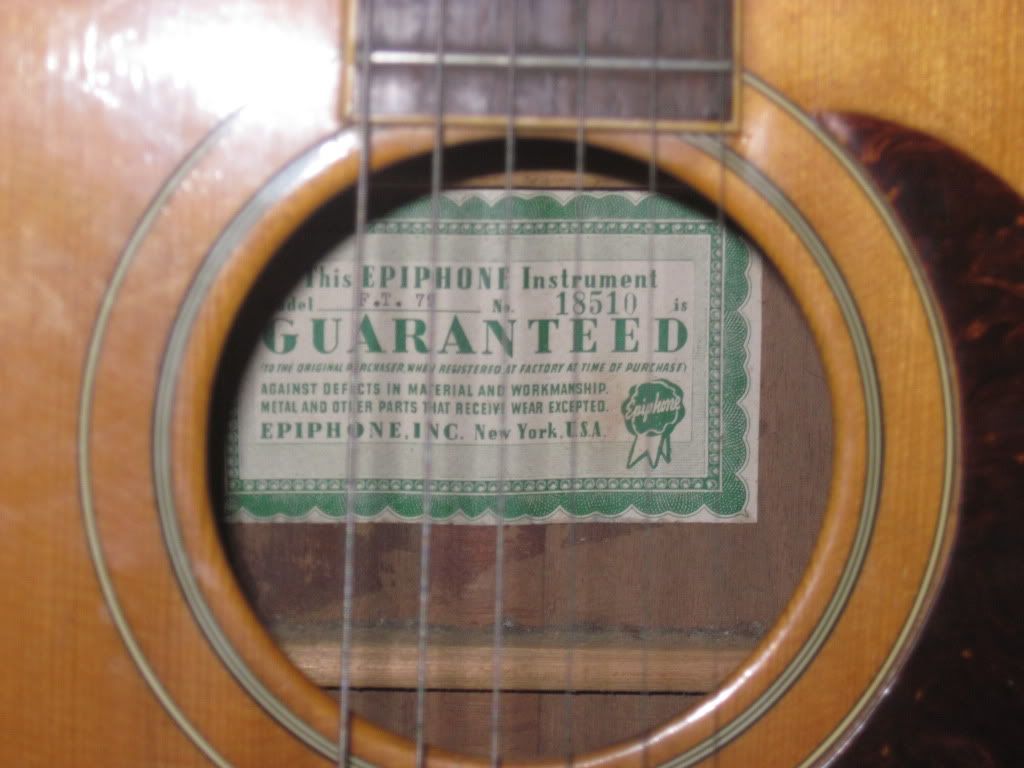
I would be impressed if you knew what this was just from the picture.  I sure didn't.  All I knew was that this was not your typical Asian made Epiphone.  This was a pre-Gibson buyout Epiphone flat top which have been aptly described as "rare as hen's teeth."  After a bit of research I found that this was the presursor to the Gibson-made Epiphone Texan.  This was a 1943 Epiphone F.T.-79.  Good luck finding another one of these at any price.


Having little knowledge of Epiphone flat-tops, I posted this picture on the Gibson guitar forum that I am a part of.   There was a guy on there that is a fellow vintage guitar guy that told me what it was and how uncommon they really are.  They are especially uncommon in this good of shape!


A buddy of mine agreed to come with me on the road trip but I decided to call the seller one more time before we left.  He had just sold it to a buyer in California.  I posted on the forum on how it had sold and the guys were giving their condolences when all of the sudden there was a new member on the forum.  It was the buyer in California!  He was a very cool guy and certainly deserved this fine, rare bird. 


Of course, there were a few scores that I didn't expect.  One of them was this little number:


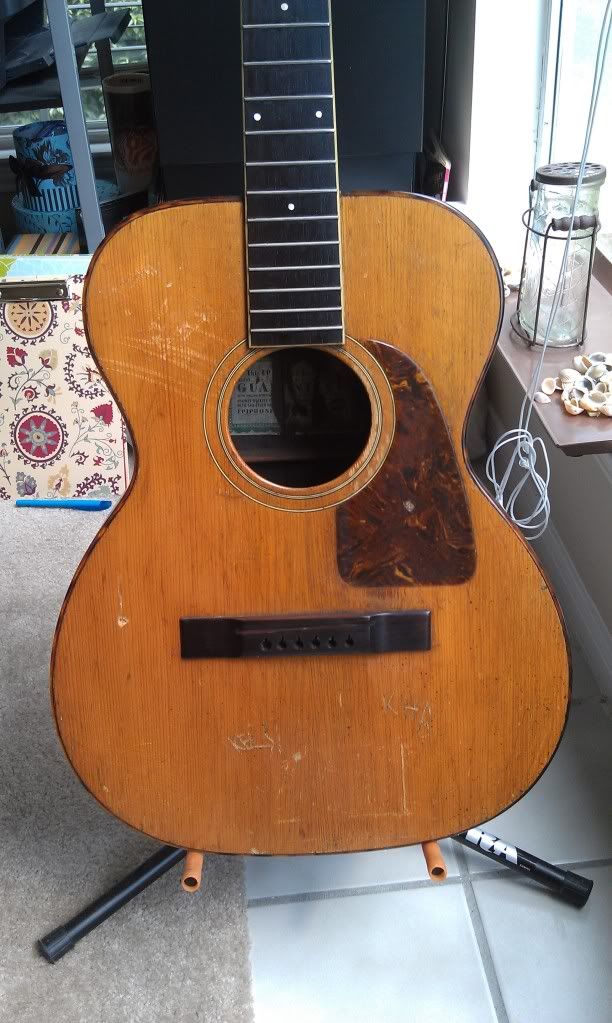
This Epiphone is from roughly the same time period (WWII).  It sort of fell into my lap.  It had been through a house fire and ownership by a someone who decided to carve her name into the top.  She apparently like stickers and glue as well.  Strangely enough her name was "Kelsey".  This happens to be my wife's first name.  Strange how that works out.